For the teacher — six documents
Planning, assessing and recording. Two lesson plan formats, because they do different jobs.
1Syllabus
Full-year syllabus — grade level standard, the three content domains, all four CG quarters, all 51 competencies across 33 weeks, grading weights and a verification checklist. Names Week 27 — special triangles plus the whole of direct and inverse variation — as the most overloaded week in this repository, and recommends lifting variation out of it entirely.
2aLesson Plan — ILAW
The whole week, in the format you file. Five days, one representation at a time: from a context, then from a graph, then from an equation, then from a table, then all three together. The zero is judged for meaning on every one of them.
2bLesson Plan — Lesson Exemplar
Day 1, at teaching depth. Timed to the minute. The class sentence is “Twelve pesos per what? Say the unit, or you have not said the slope.” Objective 4 is recognising a zero that is a valid number with no meaning — and it is the objective the other three exist to serve.
+Assessment Pack
A Table of Specifications, three complete papers with answer keys and marking notes, a weekly check, and four performance-task rubrics. The single most diagnostic item on the paper is a table where y falls 12 for every 4 of x: a learner answering −12 instead of −3 will misread every table in Grade 10.
3.3Offline Activities
Three individual options and two group options. Per What? asks only for units — no computing at all. Three Ways, One Function is a sixteen-card matching set, four functions across four representations, and its last round has teams invent a fifth and swap it.
+Class Record
Enter raw scores, get the grade. Written Works 20 · Performance Tasks 50 · Examinations 30, with the examination component split ST1/ST2/TE. Carries the SY 2026–2027 adjusted transmutation and the SY 2027–2028 zero-based rule as a switch. Saves nothing, sends nothing.
For the class — four materials
What the learners see, use and hold.
3.1Slide Presentation
15 slides timed to the lesson plan. One colour means rate and one means amount, and they keep those jobs on the worksheet and the wall chart too. Slide 10 puts the meaningless zero beside the meaningful one at the same size — the difference is the lesson, not the arithmetic.
3.2Interactive Game
Per What? — three rounds: name the rate with its unit, find slopes and zeros from equations, tables and stories, then reason about whether a zero means anything. Every slope and zero is computed from integers and shown exactly, never rounded, so no option is ever “nearly” right.
+Learner Worksheet
The one artifact a learner actually holds. Printable A4. Every slope has a separate ruled box for its unit, because a single blank invites a bare number. Two of the five zeros in Section D mean nothing — a learner who writes a meaning on all five has not read the question, and that shows at a glance while marking.
+Wall Chart
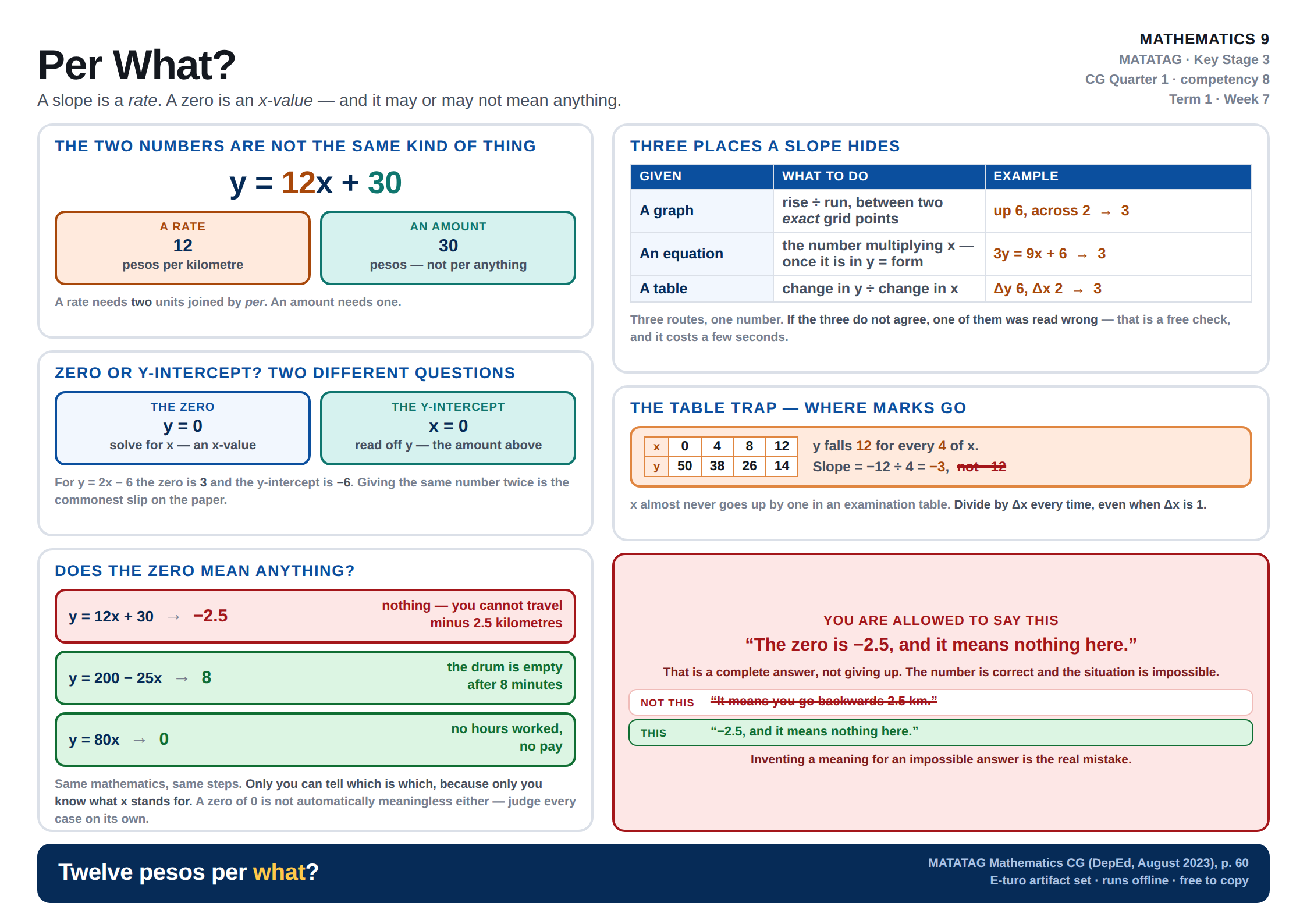
A printable A4 landscape reference — the two numbers in an equation and why they are different kinds of thing, the three places a slope hides, the table trap, and three zeros judged side by side. The red panel is not a warning but a permission. Also as PDF and HTML.
Verified against the official CG
Standards and competencies are quoted from the official MATATAG Mathematics Curriculum Guide (DepEd, August 2023) — Grade 9 sits on pages 23 and 60–64. Every slope, zero and table in every artifact was recomputed by script, and the game was exercised over 24 000 questions to confirm that each one has exactly one correct answer and no two options that read alike.
Also in this grade
Further materials, listed here so they are not missed.
+Week Planner
For the teacher. All 33 weeks of the year, with the curriculum guide competency for each.
+Common Misconceptions
For the teacher. 7 misconceptions this week, and what to do about each.
+Observation Card
For the teacher. Eight slips to cut apart — one per learner — for recording their exact words.
+What Good Work Looks Like
For the class. The standard, stated to the learner before the task rather than after.
+Per What?
For the class. A different route to slope as a rate of change, starting further back than the main worksheet. Four tasks, each with a worked example, and an answer key for the teacher.
+Per What?
For home. A slope is never just a number. A ten-minute activity with household objects, what to avoid, and how to tell it is working.