For the teacher — six documents
Planning, assessing and recording. Two lesson plan formats, because they do different jobs.
1Syllabus
Full-year syllabus — grade level standard, the three content domains, all four CG quarters, all 51 competencies across 33 weeks, and a verification checklist. It also sets out why Week 7 is deliberately placed after place value and before comparing — you cannot round a number whose places you cannot see.
2aLesson Plan — ILAW
The whole week, in the format you file. Five days: which is nearer, the nearest ten, once only, from the original, the nearest thousand, then the game and the check. Day 3 is given over entirely to chain rounding.
2bLesson Plan — Lesson Exemplar
Day 1, at teaching depth. Timed to the minute. The class votes in the first six minutes and the vote is left unsettled until minute 18 — and then it is settled by measuring, not by arguing. Seven anticipated misconceptions, including the one the strongest children ask: “is a rounded number wrong?”
+Assessment Pack
A Table of Specifications, three complete papers with answer keys and marking notes, a weekly check, and four rubrics. 20 items, not 40. Item 9 of Paper 2 is the one that surprises: 149 to the nearest thousand is 0, not 1 000. It also carries the five descriptive levels for SY 2028–2029, when Grade 3 moves off numerical grading — the last grade to do so.
3.3Offline Activities
Three individual options and two group options. The floor number line is at the centre of all of them — children measure the distance with their feet, not their eyes. In Ang Pagtatalo (the dispute) a group judges another child's answer, and four of the eight are correct, so they are forced to measure all of them.
+Class Record
Enter raw scores, get the grade. But it supplies no weights — this repository does not hold the Key Stage 1 weights, so the teacher enters the three percentages and the record refuses to produce a grade until they add to 100. Saves nothing, sends nothing.
For the class — four materials
What the learners see, use and hold. These four are in Filipino only.
3.1Slide Presentation
13 slides timed to the lesson plan. Length, not colour, carries the meaning: the two parts of the line are divided by a rule, so which one is shorter still reads on an old projector.
3.2Interactive Game
Alin ang Mas Malapit? (which is nearer?) — three rounds: which candidate is nearer, round to the unit asked for, and judge another child's answer. The numbers are deliberately chosen to be caught by chain rounding: left to chance only three in every hundred are affected — and that trap is the whole lesson.
+Learner Worksheet
The one artifact a learner actually holds. Printable A4. There are two boxes for the distances before every answer — with a single blank, it is a 50-50 guess. All five numbers in Section D are ones that chain rounding gets wrong.
+Wall Chart
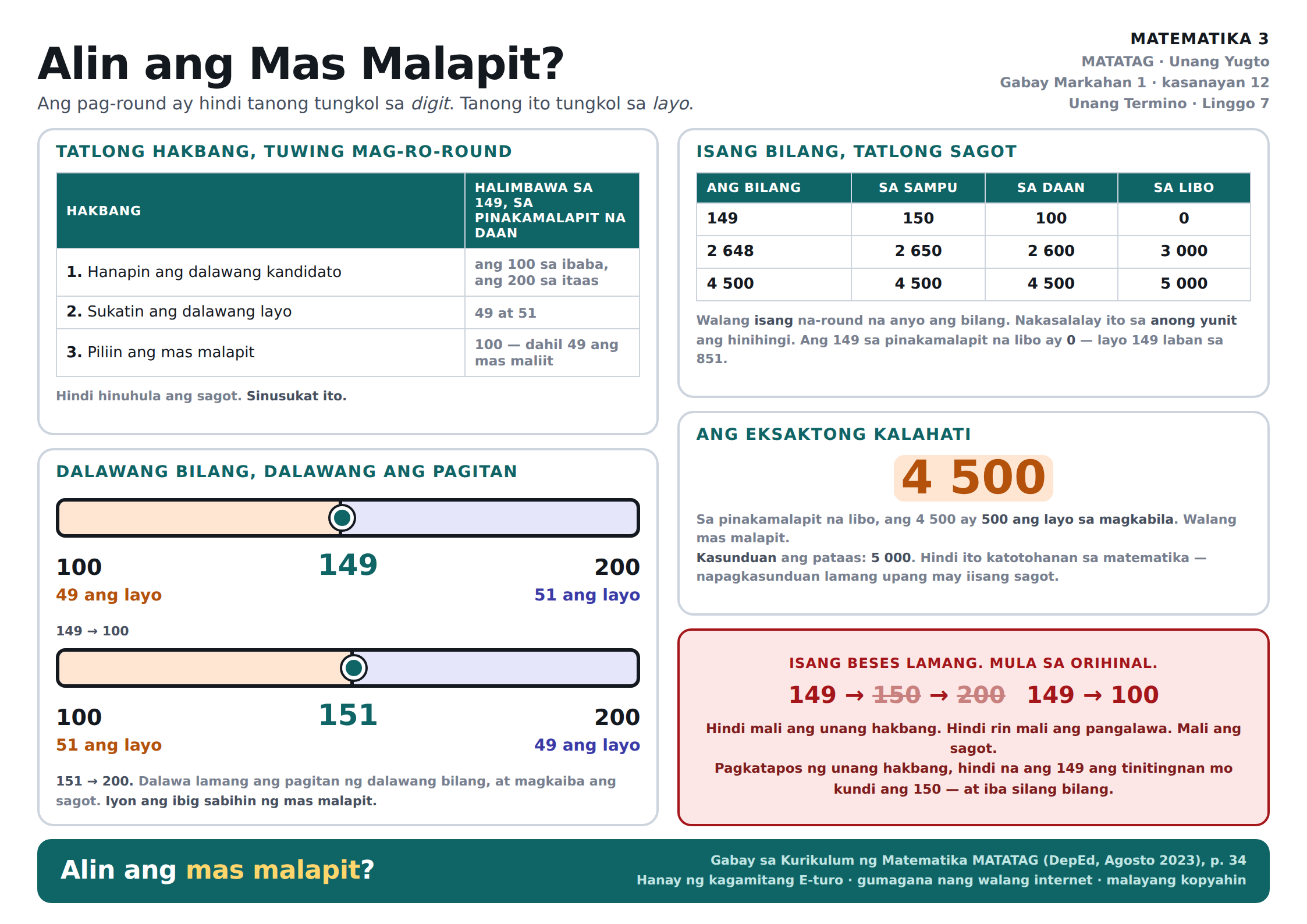
A printable A4 landscape reference — the three steps, two number lines with only two gradations, the one number with three answers, and the exact half as an agreement. The red panel shows how an answer comes out wrong with no wrong step in it. Also as PDF and HTML.
Verified against the official CG
Standards and competencies are quoted from the official MATATAG Mathematics Curriculum Guide (DepEd, August 2023) — Grade 3 sits on pages 21 and 34–38. Every distance and every rounded answer in every artifact was recomputed by script, and the game was exercised over 150,000 questions — including an independent calculation of the chain-rounded result, to confirm that the wrong answer is always on the board.
Also in this grade
Further materials, listed here so they are not missed.
+Banghay ng 33 Linggo
For the teacher. Ang buong taon, kasama ang kasanayan mula sa gabay sa bawat linggo.
+Common Misconceptions
For the teacher. 7 misconceptions this week, and what to do about each.
+Observation Card
For the teacher. Eight slips to cut apart — one per learner — for recording their exact words.
+Ano ang Mahusay na Gawa
For the class. Ang pamantayan, sinasabi sa mag-aaral bago ang gawain at hindi pagkatapos.
+Ilang Hakbang? — Karagdagang Gawaing Papel, Matematika 3
For the class. Apat na gawain mula sa paglakad sa linya ng bilang patungo sa dalawang layo. A4, kayang kopyahin nang itim-at-puti.
+Alin ang Mas Malapit? — Gabay sa Bahay, Matematika 3
For home. Baitang 3 Matematika, Unang Termino Linggo 7 — sampung minutong gawain sa bahay gamit ang tansan at butil ng bigas, tatlong dapat iwasan, at kung paano malalaman na umuubra. A4, kayang i-print nang itim-at-puti.