For the teacher — six documents
Planning, assessing and recording. Two lesson plan formats, because they do different jobs.
1Syllabus
Full-year syllabus — grade level standard, the three content domains, all four CG quarters, all 46 competencies across 33 weeks, grading weights and a verification checklist. Names Week 31 — one competency carrying six distinct circle-angle relationships — as the most under-resourced week in this repository, and says where Term 3's extra week should go.
2aLesson Plan — ILAW
The whole week, in the format you file. Five days: the two-step routine, then linear boundaries and the origin trap, then quadratic boundaries both ways up, then judging a given point, then one region written many ways.
2bLesson Plan — Lesson Exemplar
Day 1, at teaching depth. Timed to the minute. The class votes on the two inequalities in the first six minutes and the vote is not settled until minute 28 — settled by substituting, not by arguing. Seven anticipated misconceptions, including the one strong learners raise: can one point really settle a whole region?
+Assessment Pack
A Table of Specifications, three complete papers with answer keys and marking notes, a weekly check, and four performance-task rubrics. Carries one marking rule for the whole term: every graphed region must show a circled test point, because half of all single-inequality questions can be shaded correctly by guessing.
3.3Offline Activities
Three individual options and two group options. In, Out, or On strips the competency of all drawing. The Test Point Relay gives each of five learners exactly one step — and three of its eight strips cannot use the origin, without saying so.
+Class Record
Enter raw scores, get the grade. Written Works 20 · Performance Tasks 50 · Examinations 30, with the examination component split ST1/ST2/TE. Carries the SY 2026–2027 adjusted transmutation and the SY 2027–2028 zero-based rule as a switch. Saves nothing, sends nothing.
For the class — four materials
What the learners see, use and hold.
3.1Slide Presentation
15 slides timed to the lesson plan. One parabola is drawn once as inline SVG and reused across three slides, so the worked example is the same object the class met on the boundary slide. The graph's vertical range stretches to contain its own test point — a slide saying “test (0, −10)” beside an axis that stops at −7 is worse than no graph.
3.2Interactive Game
Test a Point — three rounds: place a point as in, out or on; run the two-step routine; then reason about same-versus-different regions and the origin trap. Boundaries use integer coefficients, so a point reported “on the boundary” is exactly on it and no verdict is decided by rounding.
+Learner Worksheet
The one artifact a learner actually holds. Printable A4, with the two-step routine printed at the top so it is never out of sight. The test point gets its own ruled column. Three of Section C's six boundaries pass through the origin, and the sheet does not say which.
+Wall Chart
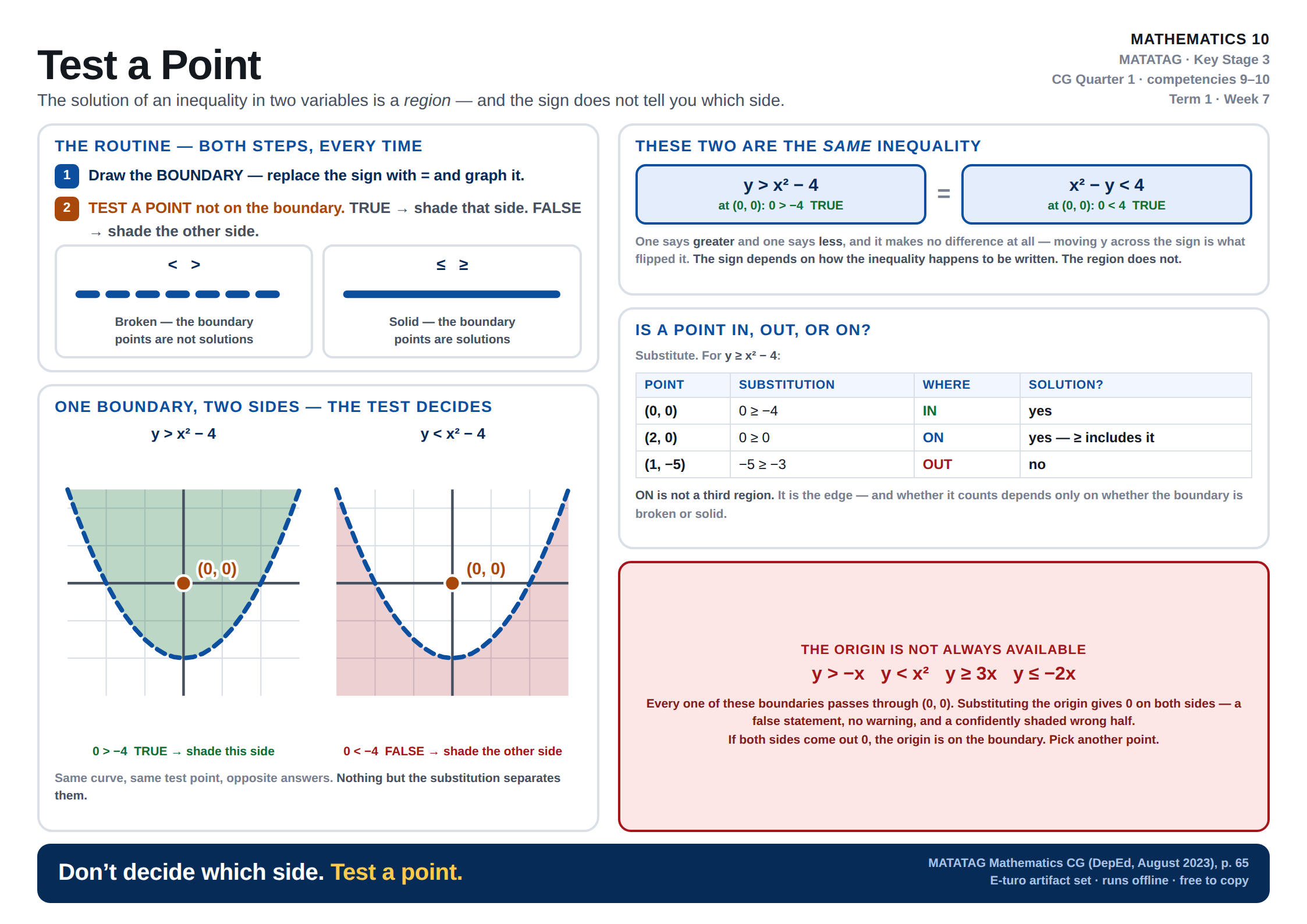
A printable A4 landscape reference — the two-step routine, broken versus solid, one boundary shaded both ways from the same test point, the in/out/on table, and the origin trap. Every shaded region carries two signals, a fill and a line style, so a greyscale photocopy loses nothing. Also as PDF and HTML.
Verified against the official CG
Standards and competencies are quoted from the official MATATAG Mathematics Curriculum Guide (DepEd, August 2023) — Grade 10 sits on pages 24 and 65–69. Every region claim was checked by brute force over a lattice of points, not by reasoning about the algebra, and the game was exercised over 24 000 questions with each printed inequality parsed back and re-evaluated from scratch.
Also in this grade
Further materials, listed here so they are not missed.
+Week Planner
For the teacher. All 33 weeks of the year, with the curriculum guide competency for each.
+Common Misconceptions
For the teacher. 7 misconceptions this week, and what to do about each.
+Observation Card
For the teacher. Eight slips to cut apart — one per learner — for recording their exact words.
+What Good Work Looks Like
For the class. The standard, stated to the learner before the task rather than after.
+More Answers Than You Can List
For the class. A different route to inequalities in two variables and the region of solutions, starting further back than the main worksheet. Four tasks, each with a worked example, and an answer key for the teacher.
+Every Answer That Works
For home. Some questions have a region of answers, not one. A ten-minute activity with household objects, what to avoid, and how to tell it is working.