For the teacher — six documents
Planning, assessing and recording. Two lesson plan formats, because they do different jobs.
1Syllabus
Full-year syllabus — grade level standard, the three content domains, all four CG quarters, all 51 competencies across 33 weeks, grading weights and a verification checklist. Flags that the CG puts a financial competency inside the geometry quarter, says it is not a pedagogical pairing, and suggests where to move it.
2aLesson Plan — ILAW
The whole week, in the format you file. Five days: what "completely" means, then common monomial factor, difference of two squares, trinomials and perfect squares, then choosing the method. Includes the decision routine as it goes on the board.
2bLesson Plan — Lesson Exemplar
Day 1, at teaching depth. Timed to the minute. Seven anticipated misconceptions — including the dangerous one where a learner decides that incomplete means wrong and starts abandoning correct intermediate steps.
+Assessment Pack
A Table of Specifications, three complete papers with answer keys and marking notes, a weekly check, and four performance-task rubrics. Factoring takes 22.5% of the term paper for one week of teaching — the heaviest single-week weighting in this repository, and the marking notes say why.
3.3Offline Activities
Three individual options and two group options, including cardboard algebra tiles — a trinomial factors when its tiles form a rectangle, and the sides are the factors. The final activity has teams set factoring traps for each other.
+Class Record
Enter raw scores, get the grade. Written Works 20 · Performance Tasks 50 · Examinations 30, with the examination component split ST1/ST2/TE. Carries the SY 2026–2027 adjusted transmutation and the SY 2027–2028 zero-based rule as a switch. Saves nothing, sends nothing.
For the class — four materials
What the learners see, use and hold.
3.1Slide Presentation
15 slides timed to the lesson plan. The three candidate answers are shown at identical size and weight — giving any of them visual priority would answer the question the slide is asking. Green means finished, amber means correct but unfinished; nothing is marked red, because nothing here is wrong.
3.2Interactive Game
Look Again — three rounds: judge whether a factorisation is finished, factor completely, then reason about how many moves it needs. Every question is built by multiplying known factors and asking for them back, so the game cannot present an answer that fails to expand to its own question.
+Learner Worksheet
The one artifact a learner actually holds. Printable A4. Section A asks only for a judgement — no factoring at all — because telling finished from unfinished is the competency and can be assessed on its own. Two of its rows are already complete, and one of those looks as if it should not be.
+Wall Chart
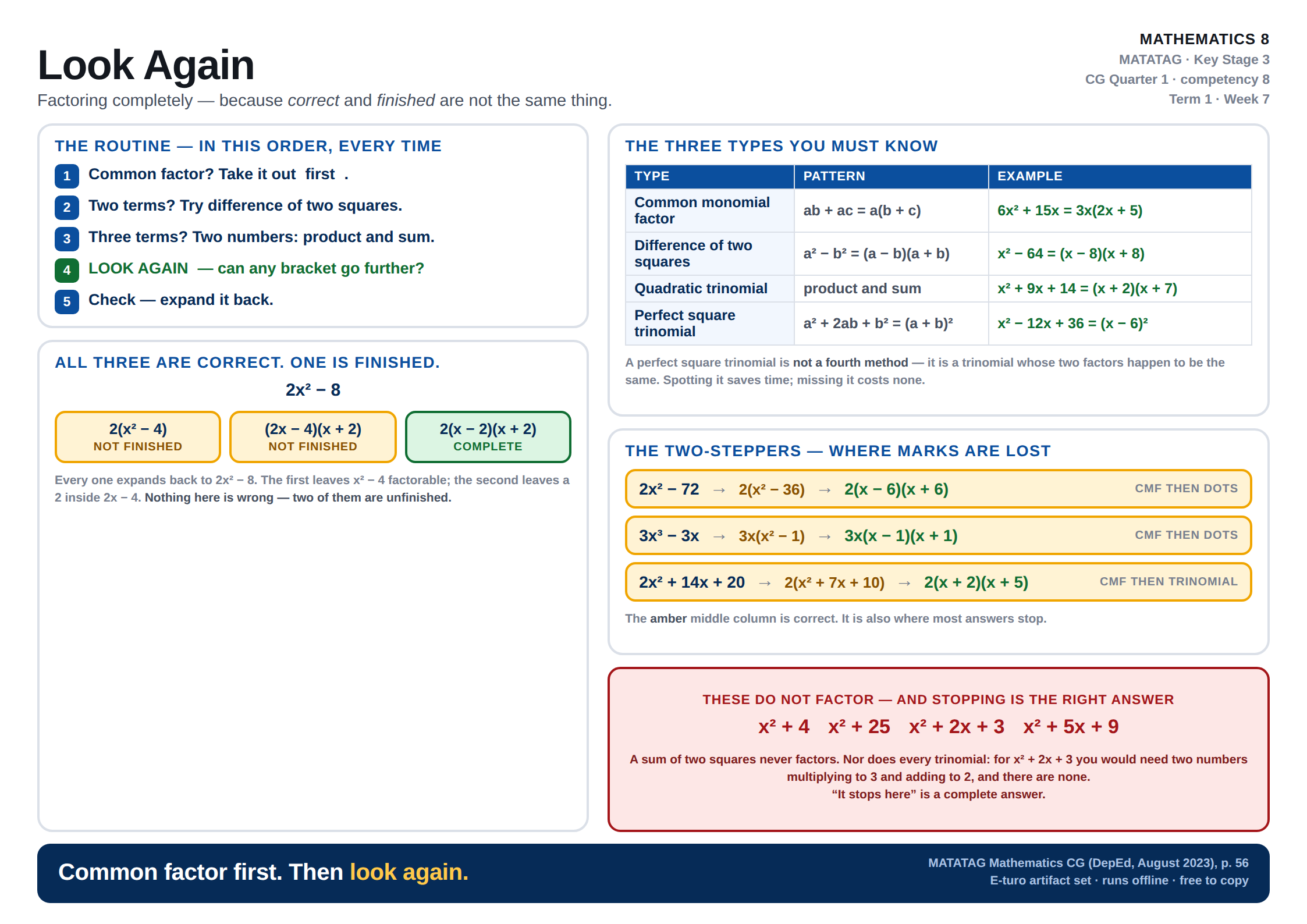
A printable A4 landscape reference — the five-step routine, the three answers to 2x² − 8, all four factoring patterns with worked examples, the two-steppers where marks are lost, and four polynomials that do not factor, because "it stops here" is a complete answer. Also as PDF and HTML.
Verified against the official CG
Standards and competencies are quoted from the official MATATAG Mathematics Curriculum Guide (DepEd, August 2023) — Grade 8 sits on pages 23 and 56–59. Every factorisation in every artifact was verified by expanding it back with a script, and every "does not factor" claim was checked for integer roots.
Also in this grade
Further materials, listed here so they are not missed.
+Week Planner
For the teacher. All 33 weeks of the year, with the curriculum guide competency for each.
+Common Misconceptions
For the teacher. 7 misconceptions this week, and what to do about each.
+Observation Card
For the teacher. Eight slips to cut apart — one per learner — for recording their exact words.
+What Good Work Looks Like
For the class. The standard, stated to the learner before the task rather than after.
+What Do They Share?
For the class. A different route to factoring polynomials completely, starting further back than the main worksheet. Four tasks, each with a worked example, and an answer key for the teacher.
+Taking Out What Everything Shares
For home. Factoring is unmultiplying, and it can be checked. A ten-minute activity with household objects, what to avoid, and how to tell it is working.