For the teacher — six documents
Planning, assessing and recording. Two lesson plan formats, because they do different jobs.
1Syllabus
Full-year course syllabus — grade level standard, the three content domains, all four CG quarters, all 52 competencies mapped across 33 weeks, DepEd grading weights, and a verification checklist. Names Quarter 4 as the pinch point of the grade — fourteen competencies in seven weeks, containing the first variable a learner ever meets — and says where to find the time.
2aLesson Plan — ILAW
The whole week, in the format you file. Intentions · Learning Experiences · Assessment · Ways Forward — the template DO 009 s. 2026 prescribes for SY 2026–2027. Five days from the two-column ledger to checking a real advertised discount, with the multiplier withheld until Day 2 on purpose.
2bLesson Plan — Lesson Exemplar
Day 1, at teaching depth. A 45-minute lesson timed to the minute. Seven anticipated misconceptions with scripted responses, full answer keys, three-tier differentiation, and a lesson that needs a board and nothing else.
+Assessment Pack
A Table of Specifications for the term, three complete papers — Summative 1, Summative 2 and the 40-item Term Examination — with full answer keys and marking notes, a weekly written check, and rubrics for all four performance tasks. Every figure verified before shipping.
3.3Offline Activities
Three individual options and two group options. No electricity, no devices, no budget — and no calculators, deliberately. The final group activity hands learners four real-shaped advertising claims and asks which are true, which are false, and which are true but misleading.
+Class Record
Enter raw scores, get the grade. Written Works 20 · Performance Tasks 50 · Examinations 30, with the examination component split ST1/ST2/TE. Carries the SY 2026–2027 adjusted transmutation and the SY 2027–2028 zero-based rule as a switch. Runs in the browser, saves nothing, sends nothing.
For the class — four materials
What the learners see, use and hold.
3.1Slide Presentation
15 slides timed to the lesson plan, built round the two-column ledger. Increase is one colour, decrease another, and the two peso amounts are always shown at the same size — because the whole lesson is that they are different. Prints as a one-slide-per-page handout.
3.2Interactive Game
Percent of What? — three rounds: find a percentage, apply it, then reason. Every amount is held in centavos as a whole number, so no answer can drift by a rounding error. Wrong options model real errors — taking the second percentage of the original, adding two discounts — so the feedback names the mistake.
+Learner Worksheet
The one artifact a learner actually holds. Printable A4, one page. Its ledger has a blank for the base on every line, so the sheet cannot be completed without stating what each percentage is a percentage of — and a learner who writes the original amount twice is visible at a glance.
+Wall Chart
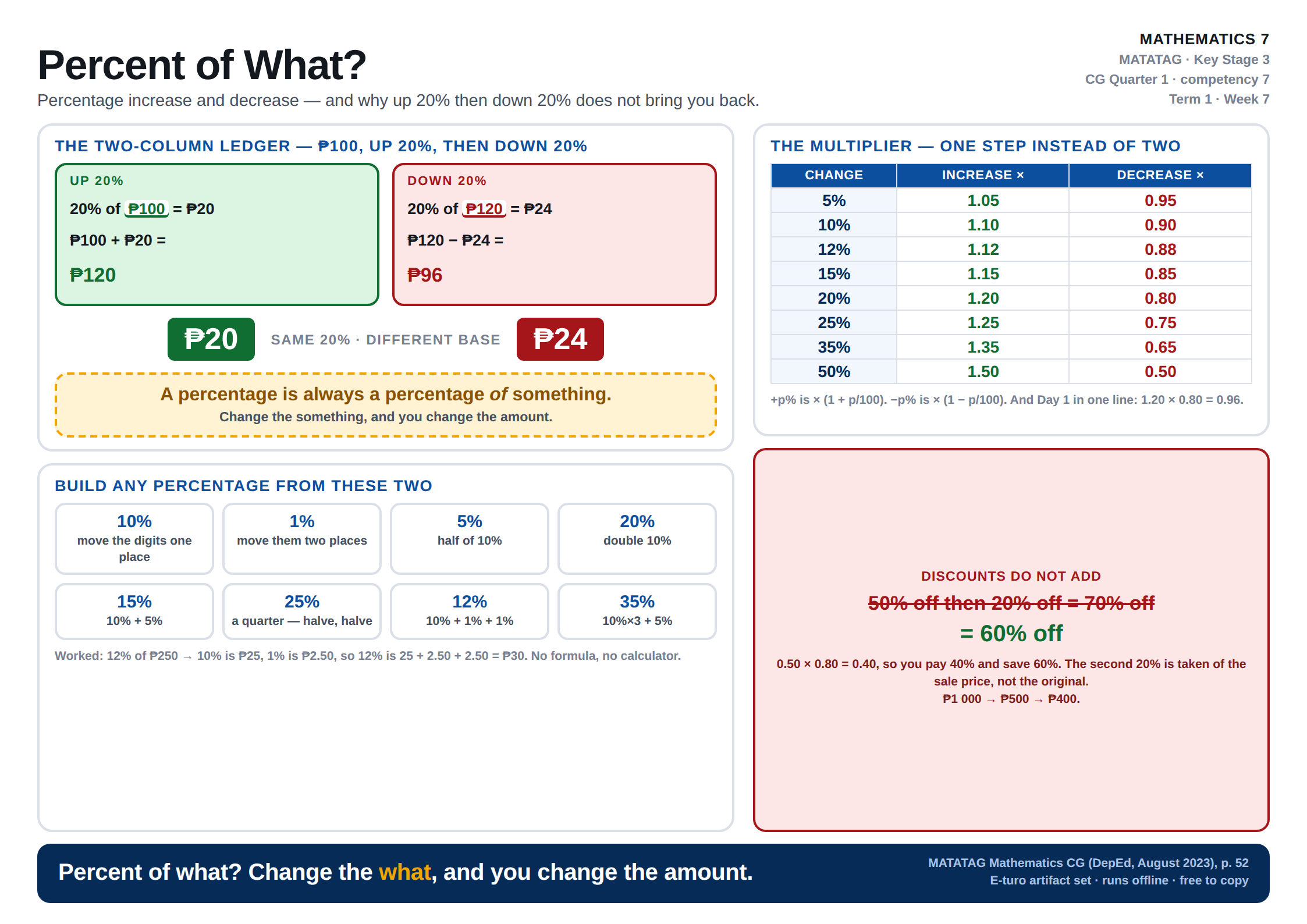
A printable A4 landscape reference — the worked ledger, the eight building blocks that make any percentage from 10% and 1%, a sixteen-entry multiplier table, and why 50% off then 20% off is 60% and not 70%. Also available as PDF and HTML.
Verified against the official CG
Standards and competencies here are quoted from the official MATATAG Mathematics Curriculum Guide (DepEd, August 2023) — Grade 7 sits on pages 23 and 52–55. Note that the Key Stage 3 grading attribution in the syllabus §6 is an inference from reporting, and is labelled as one.
Also in this grade
Further materials, listed here so they are not missed.
+Week Planner
For the teacher. All 33 weeks of the year, with the curriculum guide competency for each.
+Common Misconceptions
For the teacher. 7 misconceptions this week, and what to do about each.
+Observation Card
For the teacher. Eight slips to cut apart — one per learner — for recording their exact words.
+What Good Work Looks Like
For the class. The standard, stated to the learner before the task rather than after.
+Per Cent of What?
For the class. A different route to percentage increase and decrease, starting further back than the main worksheet. Four tasks, each with a worked example, and an answer key for the teacher.
+Up Twenty, Down Twenty, Not Back
For home. Why a discount never quite undoes a price rise. A ten-minute activity with household objects, what to avoid, and how to tell it is working.